
Artsonify & the Future of AI-Driven Visual Sound
Nov 24, 2025
Introduction: When Sound Becomes Vision in a Machine-Shaped World
Visual sound is entering a new era. AI now generates waveforms, re-renders spectrograms, animates imagined acoustics, and composes music that has never been heard before. The frontier is shifting from “sound as input” to “sound as imagination.”
At the same time, Artsonify continues its mission through a different path—revealing the natural geometry of vibration through real frequencies, real cymatic behavior, and real acoustic data, not machine prediction.
This article explores where AI and visual sound are headed—and how Artsonify fits into that future without compromising its non-AI identity.

1. Visual Sound Before AI: A Short Lineage
AI didn’t invent visual sound. It merely accelerated it. Long before neural networks, artists visualized audio through:
-
Spectrograms
-
Oscilloscope art
-
Laser interferometry
-
Cymatic vibration plates
-
Analog video synthesizers (like the Sandin Image Processor)
-
Frequency-to-color translation systems
-
Sonification tools used in astrophysics
Artsonify belongs to this lineage—not the AI-powered one. It maps real sound waves into color and form using the physics of vibration, not generative models.
2. The New AI Landscape: Sound as Synthetic Signal
AI is reshaping how sound becomes image. Key breakthroughs include:
1. Diffusion-based spectrogram generation
Models like Stable Audio and Suno can create audio from text, then visualize it through diffusion.
2. Video diffusion for audio-responsive animation
Veo, Runway, and Pika can animate movement tied to rhythm or spectral amplitude.
3. Cross-modal generation
Text → sound
Sound → image
Image → sound
Music → motion graphics
4. Real-time sound-to-visual filters
Neural shaders and mobile ML pipelines that translate sound into live motion fields.
These systems “imagine” sound rather than reveal it.
3. What Makes Artsonify Different in an AI-Flooded World
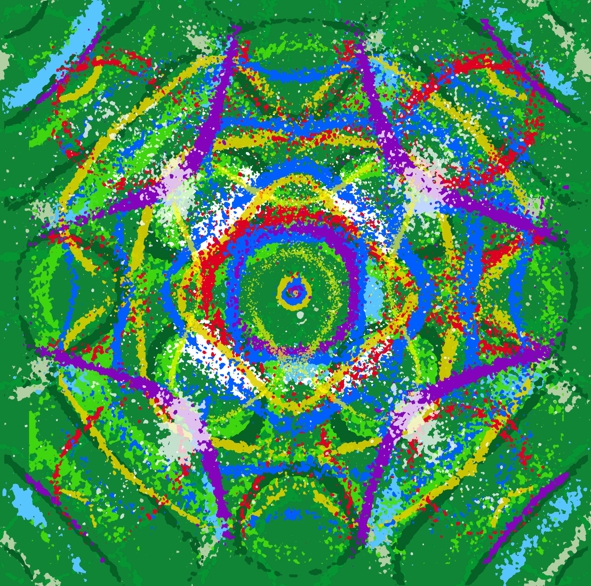
"Adventure of a Lifetime" - CP (Vibravisions Series by Artsonify)
Artsonify does not use AI.
Artsonify’s method is:
-
non-AI
-
non-machine-learning
-
non-predictive
Artsonify uses:
-
cymatic physics
-
spectrogram analysis
-
harmonic structure
-
amplitude and frequency mapping
-
chromatic interpretation of real audio signals
There is zero generative inference.
While many visual sound platforms use AI to invent sound, Artsonify uses physics to reveal it.
It doesn't imagine. It witnesses.
4. AI as Creative Partner (for Others) — Not Artsonify
AI’s role in visual sound elsewhere is growing:
-
Generating new sound textures
-
Animating imagined soundscapes
-
Creating synthetic musical visualizations
-
Training multimodal models to “hear” color or “see” rhythm
-
Building auto-visualizers in music apps
-
Reinventing VJ and motion design workflows
But this is a parallel universe, not Artsonify’s universe. Artsonify remains rooted in truth-based visual sound: the authentic, unaltered geometry of vibration. AI may augment the creative world, but Artsonify preserves the integrity of real sound made visible.
5. Will Artsonify Ever Use AI? A Realistic Future Scenario
Possibly—but not in the translation process. If Artsonify ever adopts AI, it would be in:
1. Curation
AI helping organize or recommend the best frames, palettes, or compositions.
2. Interaction
AI guiding visitors through immersive sound exhibitions.
3. Discovery
AI identifying patterns across thousands of sound-derived artworks.
4. Acceleration
AI speeding up color-grading, background removal, or noise cleaning.
But never in:
-
predicting visuals
-
inventing patterns
-
creating images that don’t originate from sound itself
Artsonify’s sacred rule remains unchanged: The visual form must come from the sound. Always.
AI will never override the signal.
6. What AI Can Teach Us About Sound
Even though Artsonify doesn’t rely on AI, the AI world still offers insights into how humans interact with sound:
-
Neural networks highlight the hidden harmonics humans overlook.
-
AI-composed music shows how patterns can be reorganized.
-
Audio-responsive models reveal how computers “interpret” rhythm.
-
Multimodal models demonstrate cross-sensory creativity
These insights inspire reflection, not imitation.
Artsonify’s work gains contrast by existing outside the AI wave—like analog photography did when digital arrived.
7. The Visual Sound Ecosystem of the Future
The next decade will produce two parallel paths:
PATH A — Synthetic Sound Visualizers (AI-Driven)
-
imagined acoustics
-
artificial spectrograms
-
diffusion-based animation
-
synthetic motion graphics
PATH B — Physical Sound Visualization (Real-Data-Driven)
-
cymatics
-
frequency mapping
-
wave geometry
-
harmonic analysis
-
emotional chromatics
Artsonify belongs to Path B. But both paths will influence how audiences perceive sound. And that’s where the future gets interesting.
8. The Role Artsonify Plays in That Future
Artsonify stands at a rare intersection:
-
grounded in physics, not prediction
-
rooted in truth, not imagination
-
deeply human, not synthetic
-
expressive through emotion and frequency, not datasets
In an era where AI floods the visual world with infinite synthetic content, Artsonify’s work feels more alive—not less.
By anchoring itself in the authenticity of vibration, Artsonify becomes the counterweight the creative world needs: A reminder that not all generativity is artificial. Some of it is the universe vibrating.
Conclusion: The Real, The Artificial, and the Art of Listening
The future of visual sound will not be dominated by AI— but divided by it. Some artists will paint with imagination powered by machines. Artsonify will continue painting with the imagination of sound itself.
Both paths matter. Both enrich the ecosystem. Both expand how humans see and hear. But Artsonify preserves something irreplaceable: the direct resonance between vibration and emotion.
In a machine-shaped future, that authenticity will only grow more valuable.
FAQ: Artsonify & AI-Driven Visual Sound
1. Does Artsonify use AI to visualize sound?
No. Artsonify uses non-AI methods such as spectrograms, frequency mapping, and cymatic principles to convert real sound into visual form.
2. How is AI changing visual sound art?
AI enables synthetic soundscapes, diffusion-based visualizations, and automated animation—but these are parallel practices, not replacements for real-data visual sound.
3. What makes Artsonify different from AI-based sound visualizers?
Artsonify reveals the true geometry of actual sound waves. AI tools generate imagined or predicted visuals.
4. Could Artsonify ever use AI in the future?
Possibly for workflow or curation—but never for the sound-to-vision transformation itself.
5. What role will real-data visual sound play in an AI-driven world?
Authenticity will become increasingly valuable as synthetic content saturates the creative ecosystem.
Artsonify - "Music, Painted."