When the Maestro Meets the Modern: Kandinsky and the Future of Sound Art
Nov 20, 2025
The Dialogue Across Time: Recognizing the Invisible
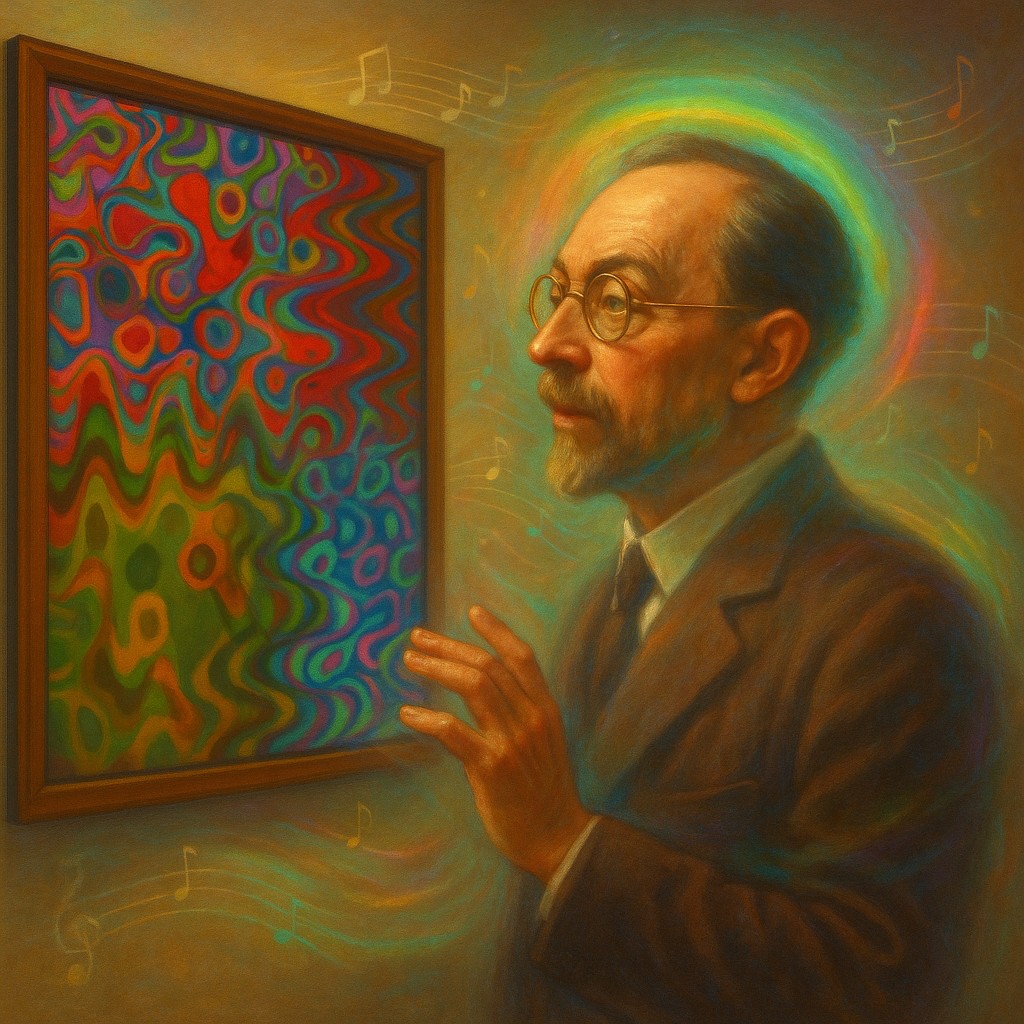
Imagine Wassily Kandinsky, the pioneer who first freed color from form, the artist who heard violins in his paint and saw blue in the deep resonance of music—imagine him stepping into a modern gallery. What would catch his eye?
The image before us is more than just a painting; it's a profound handshake across a century of abstraction. It captures Kandinsky, the founding father of non-objective art, standing before a dynamic, music-driven abstraction by Jose Antonio Torres (JAT).
Kandinsky is not merely viewing the art; he is recognizing it—like a time traveler finally recognizing a distant, yet genetically similar, artistic cousin.
The Principle of Inner Necessity
Kandinsky's revolutionary work was built on the principle of Inner Necessity—the conviction that true art must be born from the soul's emotional needs and spiritual vibrations, not just the imitation of the visible world. His canvases were maps of internal life, musical compositions translated into visual force.
This is precisely the current that connects him to JAT's Sound Art.
If Kandinsky could speak to Jose Antonio Torres today, his words would carry the weight of prophecy fulfilled:
"You are painting not the visible, but the invisible—the vibrations of the soul, the music of memory. Your colors and forms are not mere decoration, but living forces. Trust your inner necessity, and let your art continue to be a bridge between the senses, a language beyond words."
In JAT's vibrant, fluid interpretation of a song's frequencies and emotional peaks, Kandinsky would see the ultimate realization of his own theories: art that sings, art that feels, art that awakens the spirit.
The Evolution: From Spiritual Resonance to Scientific Translation
While Kandinsky sought to translate the internal, spiritual resonance of music into color, JAT and Artsonify have taken the concept into the 21st century by merging artistry with innovation.
JAT's unique technique doesn't just paint about music; it paints the music itself.
Through a rigorous, innovative process, Artsonify scientifically deconstructs a song’s frequencies and rhythms into foundational visual patterns. This technical rigor ensures the artwork is a true spectrographic portrait of the sound. The final, crucial step is the artist's Emotional Synthesis, where JAT applies his synesthesia-inspired vision to finalize the composition, texture, and color palette—ensuring the painting carries the exact joy, melancholy, or drama of the emotional peak.
The Bridge Between the Senses
This commitment to exploring the intersection of sound, memory, and emotion through abstraction is exactly the kind of artistic courage Kandinsky championed. He paved the way for abstraction to be a universal language. JAT is now proving that this language can be spoken with the specificity and precision of musical composition.
In every piece of Abstract Painted Song, you don't just see a beautiful pattern; you see the visual waveform of your favorite memory. You see the future of abstraction.
As Kandinsky would affirm: "In your work, I see the future of abstraction: art that sings, art that feels, art that awakens the spirit."
Find Your Song's Visual Soul
Which song holds the deep emotional resonance you want to capture? Explore the Artsonify collection today and discover the profound visual life of your inner music.
Artsonify - "Music, Painted."