Making Sound Visible: Cymatics and the Science Behind Artsonify
Oct 19, 2025
Introduction: Seeing What You Hear
Sound has always moved us — but what if we could see it? Every vibration carries energy, every tone leaves a trace. From the ripple on a drumskin to the shimmer of a violin string, sound shapes matter in ways too quick for the eye to follow.
Cymatics, the study of visible sound vibration, turns the invisible into image. It’s the bridge where physics meets art — and it’s the foundation of Artsonify’s creative process.
1. The Science of Cymatics
The term cymatics comes from the Greek kyma, meaning “wave.” It was coined by Swiss scientist Hans Jenny in the 1960s, who demonstrated how sound frequencies can arrange particles, sand, or liquids into intricate patterns.
But the roots go back further. In the 18th century, Ernst Chladni spread sand across metal plates and stroked them with a violin bow. The sand jumped into geometric shapes — now called Chladni figures — each pattern corresponding to a resonant frequency.
Cymatics reveals an astonishing truth: sound is architecture in motion. Every frequency builds a structure, every rhythm leaves geometry behind.
2. The Language of Vibration
Different frequencies produce different shapes:
-
Low tones form simple circles and waves.
-
Midrange frequencies create symmetrical polygons.
-
High frequencies generate complex, flower-like forms.
These are not illustrations of sound — they are sound, made visible through vibration. When viewed collectively, they resemble living mandalas, molecular blueprints, or cosmic maps.
Cymatics shows that music and form are two faces of the same vibration.
3. From Science to Studio: How Artsonify Uses Cymatics
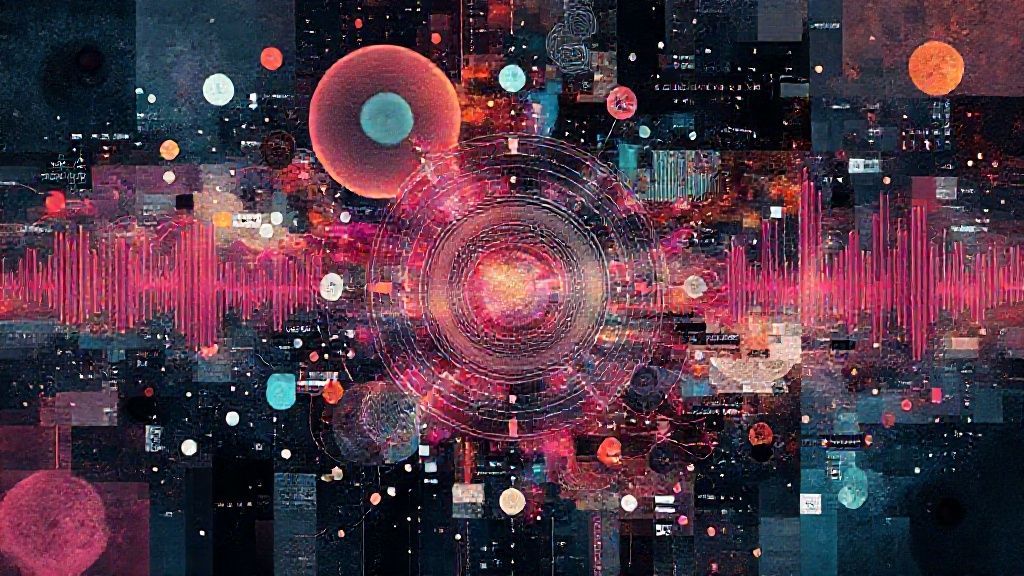
At Artsonify, we translate this natural phenomenon into contemporary art. Using a combination of sound analysis, frequency mapping, and digital artistry, each artwork begins with a song — a vibration encoded with emotion and energy.
-
Sound Analysis – The song’s frequencies, harmonics, and amplitude are extracted and analyzed.
-
Frequency Visualization – These frequencies are converted into color palettes, shapes, and rhythmic movement based on physical cymatic logic.
-
Artistic Composition – The patterns are layered, harmonized, and stylized to create a piece that reflects both the song’s structure and emotional essence.
The result: a visual artwork that embodies the spirit of sound itself.
4. The Connection Between Cymatics and Emotion
Cymatics doesn’t just reveal physical forms — it mirrors how sound feels. The brain naturally translates vibration into emotion: calm, tension, movement, peace. When we visualize these frequencies, we also visualize emotion’s texture.
That’s why every Artsonify piece feels alive — it’s not abstract by accident. It’s structured by the same physics that shape music, nature, and even the human voice.
5. Nature’s Resonance: The Universe in Pattern
Cymatic patterns appear everywhere:
-
The ripples of water struck by sound.
-
The resonance of a drum.
-
The oscillations of planetary orbits and electromagnetic fields.
Many scientists believe the universe itself behaves like a giant cymatic field — energy vibrating in different modes. Artsonify draws inspiration from this universal language of resonance.
Sound is the blueprint of creation — and cymatics is its translation.
6. Beyond the Lab: Art as Synesthetic Experience
Artsonify’s mission goes beyond scientific visualization. Each artwork is a synesthetic experience — sound crossing into sight. It invites you to feel what a song looks like and see what music feels like.
By merging scientific precision with aesthetic intuition, Artsonify turns data into emotion — transforming analysis into poetry.
7. Conclusion: The Shape of Sound
Every note, every frequency, every vibration leaves a mark on the world. Cymatics lets us glimpse that hidden geometry — the fingerprints of sound itself.
Through Artsonify’s lens, these patterns become living artworks — windows into the unseen architecture of music. The result is more than art; it’s resonance made visible.
Frequently Asked Questions About Cymatics and Artsonify
1. What is cymatics?
Cymatics is the study of how sound vibrations create visible patterns in materials like sand, water, or liquid. It reveals the geometric structures formed by different frequencies.
2. Who discovered cymatics?
The phenomenon was first explored by Ernst Chladni in the 18th century and later developed scientifically by Hans Jenny in the 1960s, who coined the term “cymatics.”
3. How does Artsonify use cymatics?
Artsonify analyzes songs and sound frequencies to create visual representations inspired by cymatic patterns, turning sound energy into contemporary visual art.
4. Are cymatic patterns real or artistic interpretation?
They are real physical patterns created by vibration. Artsonify combines authentic cymatic principles with creative interpretation to produce original compositions.
5. Why is cymatics important in art and science?
Cymatics bridges physics, biology, and creativity — showing that sound organizes matter and connects scientific understanding with artistic expression.
Artsonify – Music, Painted.