Sound Art vs. Music: Where the Line Actually Lives
Oct 13, 2025
Introduction: The Blur Between Sound and Music
At first, sound art and music seem like twins born from the same vibration — both crafted from frequencies, rhythm, and resonance. Yet one is often performed on stage, while the other is installed in a space. One asks to be listened to; the other asks to be experienced.
The difference is subtle, but it changes everything. To understand sound art, we must step beyond melody and harmony into the physical, spatial, and conceptual territory of sound itself. Sound art doesn’t just use sound; it thinks with sound.
1. From Music to Sound as Art
A brief historical detour
In the early 20th century, Italian Futurist Luigi Russolo issued a challenge to music’s polite boundaries. His 1913 manifesto The Art of Noises declared that the modern world — full of machines, factories, and engines — demanded new instruments. He built them: the intonarumori, wooden boxes that roared, hissed, and hummed like the industrial age itself.
Later, in the 1940s, Pierre Schaeffer in France recorded train sounds and manipulated them on tape, birthing musique concrète — the first music made from found sounds rather than notes.
Then came John Cage, whose radical piece 4′33″ invited musicians to sit in silence while the audience listened to the ambient sounds of the room. Cage reframed sound itself as a living material.
Each of these artists cracked open the same idea: that sound could be art — not merely a vessel for melody or rhythm, but an expressive medium on its own terms.
2. So What Exactly Is Sound Art?
Sound art is a broad and intentionally messy field. It includes sound installations, sound sculptures, soundwalks, field recordings, cymatic experiments, and site-specific works that use sound to shape space, emotion, or awareness.
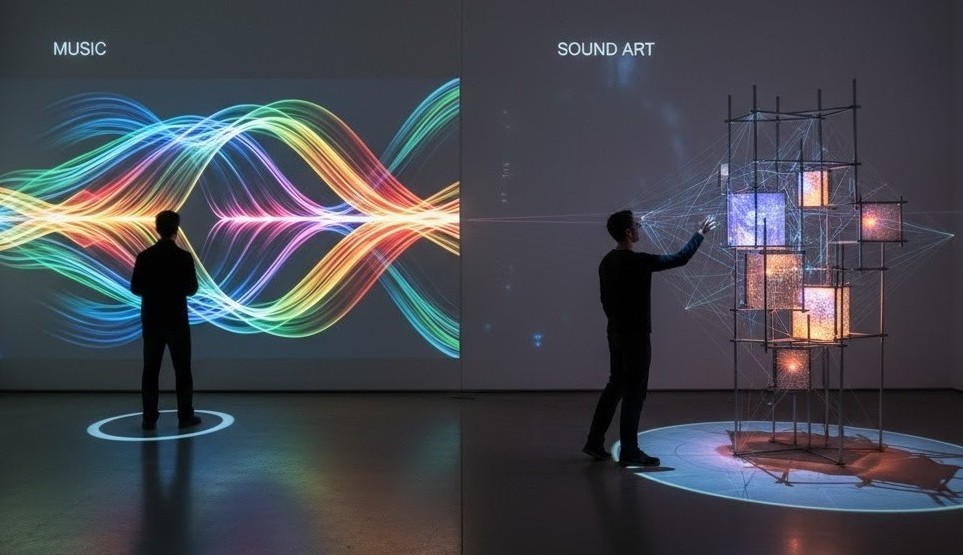
While music is generally linear — beginning, building, resolving — sound art is spatial and conceptual. It often:
-
Uses sound to activate a place or architecture.
-
Focuses on perception rather than performance.
-
Invites the listener to move, explore, or participate.
-
Blurs the line between the auditory and the visual.
If music organizes time, sound art organizes space.
3. The Key Differences (and the Overlaps)
| Aspect | Music | Sound Art |
|---|---|---|
| Purpose | Emotional communication through rhythm, melody, harmony | Conceptual exploration through sound as material |
| Form | Structured in time (songs, scores, performances) | Structured in space (installations, environments) |
| Audience Role | Passive listener | Active participant or explorer |
| Medium | Instruments, voice, digital composition | Objects, architecture, field recordings, sensors, speakers |
| Location | Concert hall, streaming platform | Gallery, public space, outdoor site |
| Tradition | Music theory, performance, notation | Contemporary art, conceptual practice, acoustics |
But the border isn’t a wall — it’s a membrane. Artists cross it freely. Many musicians (Brian Eno, Ryoji Ikeda, Janet Cardiff) create installations; many sound artists compose. What matters isn’t genre — it’s intention.
4. The Experience: Listening vs. Hearing
The philosopher Pauline Oliveros coined the term Deep Listening — the act of consciously attending to all sounds, both external and internal. In sound art, this kind of listening turns into a spatial experience.
You walk through a piece. You feel air move. The sound doesn’t come from the speakers — it inhabits the room with you. You’re not an audience member anymore; you’re part of the artwork.
That’s why many sound artists call their work “environments,” not “compositions.”
5. The Gallery vs. The Stage
In a concert, sound moves through time — it has a beginning and an end. In a sound installation, time is often open-ended. You can enter at any point; there’s no “start” or “finish.”
This difference makes curation, documentation, and even ownership tricky. How do you collect an experience that changes with every listener’s movement? Museums like MoMA, ZKM, and Dia Art Foundation have spent decades figuring out how.
Sound art demands that curators think like acoustic architects — designing how visitors move through aural space.
6. Why the Distinction Still Matters
Sound art and music share DNA, but the distinction is useful because it keeps both disciplines alive.
Without it:
-
Music risks becoming too abstract and losing its emotional power.
-
Sound art risks becoming misunderstood as “just weird music.”
For Artsonify, this distinction is vital — it’s what allows the transformation of sound into visual art. Each vibration carries information that can be shaped, interpreted, and visualized — a bridge between hearing and seeing.
7. Sound Art in the Present Tense
Today, sound art extends far beyond galleries:
-
Eco-acoustics uses sound to monitor ecosystems and climate change.
-
AI-generated sonifications translate data into audible and visual forms.
-
Haptic sound art allows the Deaf and hard-of-hearing to feel vibrations.
-
Cymatics, the visual patterns created by sound waves, bring the invisible to light — precisely what Artsonify celebrates and translates into fine art.
Sound art isn’t a niche anymore. It’s the connective tissue between music, science, technology, and visual culture.
8. Why It Belongs Here — Artsonify’s Perspective
Artsonify exists where sound art meets visual art. By transforming sound frequencies into shapes, colors, and compositions, Artsonify continues the tradition of Russolo, Schaeffer, Cage, and Oliveros — giving sound new form.
Our works visualize what your favorite songs look like in frequency and emotion. It’s not music turned into illustration — it’s sound as experience turned into art as presence.
Sound art asks us to listen differently. Artsonify asks us to see differently.
Conclusion: A New Way of Listening
Sound art and music aren’t rivals. They’re two perspectives on the same universal vibration. Music tells stories in time; sound art tells stories in space. Together, they form a continuum of human curiosity about what sound can mean — how it moves, shapes, and transforms us.
At the end, whether you’re listening to a symphony or walking through a humming room of speakers, it’s all the same question:
What does sound make us feel — and what might it look like?
Frequently Asked Questions About Sound Art
1. What is sound art?
Sound art is an artistic discipline that uses sound as its primary medium. Unlike traditional music, it often focuses on space, perception, and experience rather than melody or rhythm. Sound art can take the form of installations, sculptures, field recordings, or immersive environments that invite the listener to explore sound physically and conceptually.
2. How is sound art different from music?
Music typically organizes sound through time using rhythm, melody, and harmony. Sound art, on the other hand, organizes sound in space — through location, architecture, or interaction. While music is often performed for an audience, sound art is experienced as an environment you can move through.
3. Who started sound art?
The roots of sound art trace back to early 20th-century experiments by Luigi Russolo, whose Art of Noises manifesto challenged the limits of music. Later pioneers like Pierre Schaeffer, John Cage, and Max Neuhaus transformed everyday sound, silence, and space into artistic expression.
4. Where can I experience sound art?
Sound art can be found in museums, galleries, outdoor installations, and public spaces worldwide. Institutions like MoMA (New York), ZKM (Germany), and Dia Art Foundation have curated landmark exhibitions exploring sound as a visual and spatial medium.
5. How does Artsonify connect to sound art?
Artsonify continues the legacy of sound art by turning sound frequencies into visual compositions. Using cymatics and digital analysis, Artsonify transforms songs and soundscapes into contemporary abstract artworks — making the invisible structure of sound visible through color and form.
Artsonify.com – Music, Painted.