
The Human Ear as an Instrument: Psychoacoustics Explained
Nov 11, 2025
Introduction: The Art of Hearing
Every sound you’ve ever loved — every whisper, note, or wave — passes through a biological symphony before it becomes experience.
Your ear is not a passive receiver. It’s an instrument of interpretation. And the brain behind it doesn’t just hear — it composes meaning.
This union between physical hearing and mental perception is the realm of psychoacoustics — the science of how humans experience sound.
For sound artists and listeners alike, understanding psychoacoustics is the key to understanding why sound moves us.
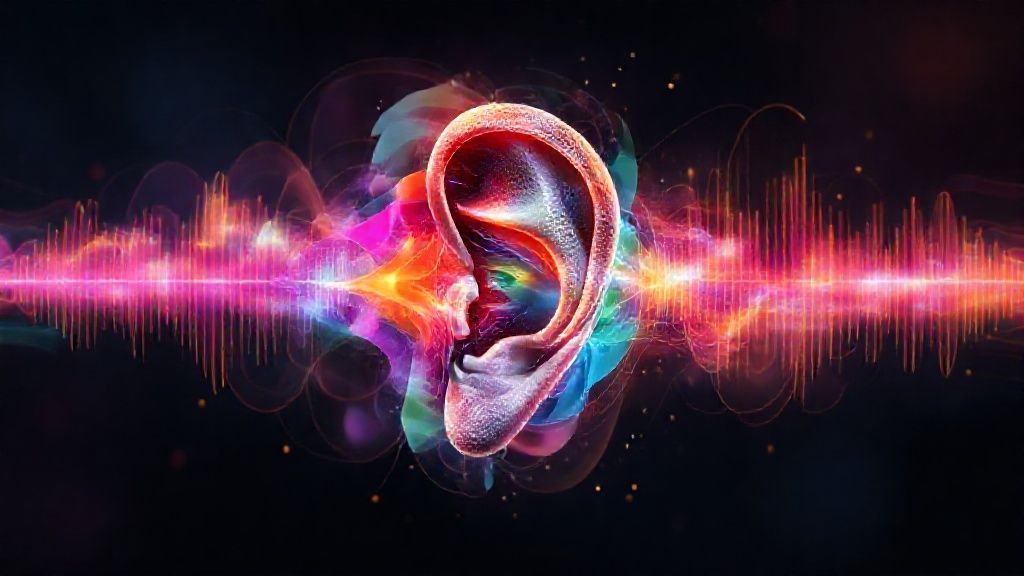
1. The Mechanics of Hearing: From Vibration to Sensation
Sound begins as vibration — air pressure waves entering the ear canal.
They strike the eardrum, move through the ossicles (tiny bones named malleus, incus, stapes), and reach the cochlea — a spiral-shaped organ filled with fluid and hair cells.
Each hair cell is tuned to a specific frequency. When it vibrates, it sends electrical signals to the brain — a code of pitch, tone, and texture.
The ear, in essence, performs spectral analysis — breaking sound into frequencies long before any computer ever did.
It’s nature’s first synthesizer.
2. The Brain’s Role: The Composer Within
The brain doesn’t hear what’s “out there.” It builds an internal version of the world based on prediction and context.
Psychoacoustics studies how the mind organizes these sensory inputs — how we perceive pitch, loudness, timbre, distance, and direction.
Our auditory cortex interprets patterns, detects rhythm, and links sound to memory and emotion.
When you recognize a voice or feel nostalgia from a melody, that’s psychoacoustics in action. Your brain is turning vibration into meaning — and meaning into feeling.
3. The Illusions of Sound
Psychoacoustics also reveals how easily hearing can be deceived. Famous examples include:
-
The Shepard Tone — an endless ascending pitch that never rises.
-
The Haas Effect — where two quick sounds are perceived as one due to auditory fusion.
-
Binaural Beats — two tones played to each ear create a third, imagined rhythm inside the brain.
These illusions show that hearing is an act of imagination. The ear listens, but the mind completes the melody.
4. Loudness, Space, and Emotion
Our perception of sound isn’t linear — it’s psychological.
-
Loudness doubles roughly every 10 decibels, but we feel it exponentially.
-
A low-frequency rumble can evoke fear; a high shimmer can evoke awe.
-
Reverb and delay create depth — spatial cues that mimic emotional distance or intimacy.
Sound designers and composers use these cues instinctively. Sound artists use them conceptually — sculpting the listener’s perception as much as the sound itself.
Artsonify takes this further, visualizing those emotional frequencies as color and form.
5. The Ear as an Artistic Tool
For sound artists, understanding psychoacoustics means learning to play the ear like an instrument.
Through resonance, silence, repetition, and rhythm, artists can manipulate how space feels and how time flows.
In installations, subtle low-end frequencies can make a room vibrate in your bones. High tones can make air shimmer — almost visible.
Psychoacoustics turns space into an emotional instrument — and the listener into co-creator.
6. Artsonify: From Hearing to Seeing
Artsonify’s work emerges from the same scientific foundation — but visualizes it. By mapping sound’s frequencies and amplitudes to visual form, it mirrors how the ear organizes experience.
A deep tone might appear as wide, slow color gradients. A sharp tone becomes angular and bright. The resulting artwork is a portrait of perception — not of sound itself, but how sound feels inside us.
Artsonify, in essence, creates the visual language of psychoacoustics.
Conclusion: The Mind Listens First
The ear gathers vibration. The brain makes sense of it. And the heart gives it meaning.
To understand psychoacoustics is to realize that sound is not just physics — it’s empathy in motion.
Every listener is both audience and instrument. And in that collaboration, sound becomes art — and hearing becomes creation.
Frequently Asked Questions About Psychoacoustics
1. What is psychoacoustics?
Psychoacoustics is the science of how humans perceive and interpret sound — how physical vibrations become sensations and emotions.
2. How does the ear process sound?
The ear converts air vibrations into electrical signals that the brain interprets as pitch, tone, and spatial information.
3. Why do some sounds trigger emotions?
The brain associates frequencies and rhythms with emotional memory and physiological responses — a key part of psychoacoustics.
4. How is psychoacoustics used in sound art?
Sound artists use psychoacoustic principles to manipulate perception — using resonance, silence, and texture to evoke emotional or spatial effects.
5. How does Artsonify visualize psychoacoustics?
Artsonify translates auditory patterns into abstract visual forms that reflect emotional frequency and perceptual rhythm.
Artsonify - "Music, Painted."