The Science of Listening: Psychoacoustics and Perception in Sound Art
Oct 30, 2025
Introduction: Hearing Is Not Listening
Sound is not what you hear — it’s what your brain makes of it. The rustle of leaves, a violin note, a heartbeat — they’re all waves in air. But inside your head, they become meaning, memory, and emotion.
This is the domain of psychoacoustics — the science of how humans perceive sound. For sound artists, it’s both a tool and a playground. By understanding how we interpret frequency, space, and vibration, they sculpt experiences that feel physical, emotional, even spiritual.
Artsonify’s approach — transforming songs into color and form — grows directly from this same science: perception as creation.
1. What Is Psychoacoustics?
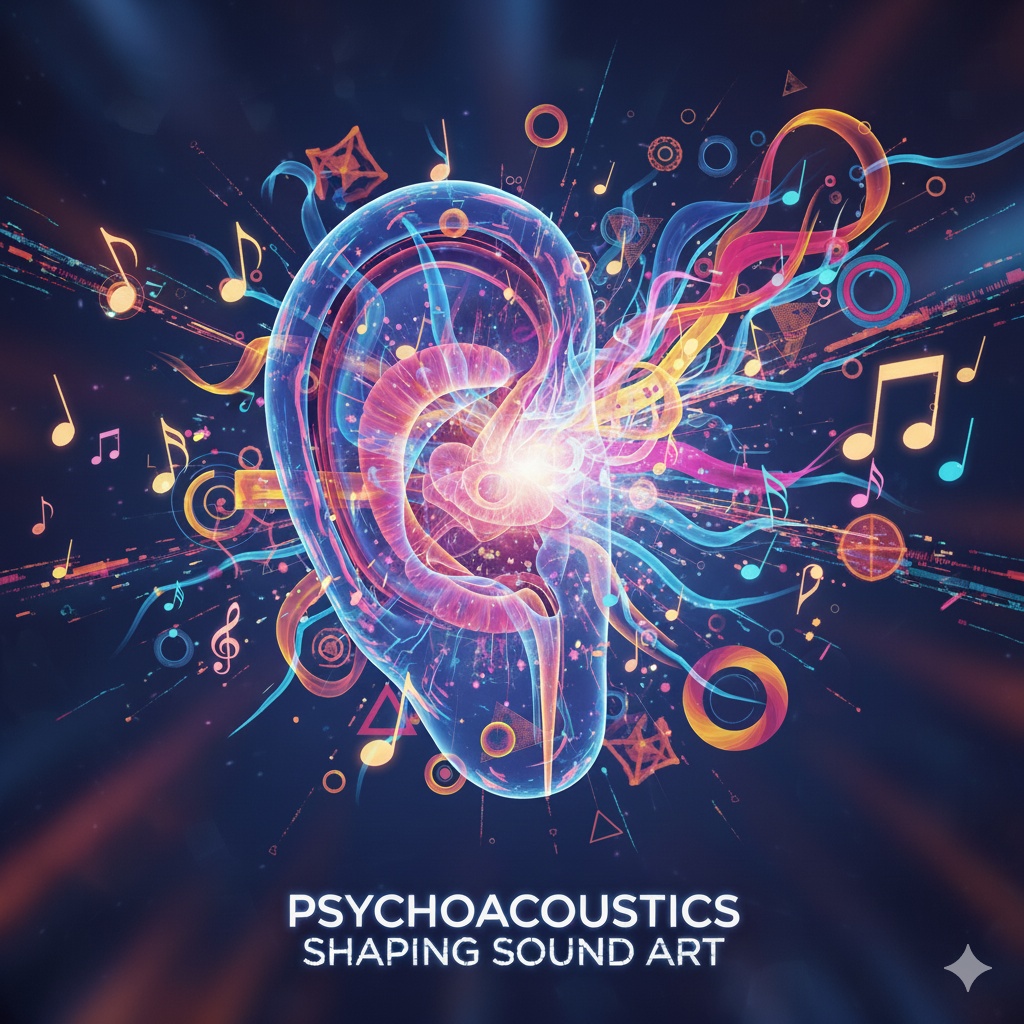
Psychoacoustics is the study of how we perceive sound — not its physical properties alone, but its psychological effects.
Where physics measures frequency and amplitude, psychoacoustics explores loudness, tone, distance, and emotion. It asks:
-
Why does a minor chord sound sad?
-
Why does low-frequency bass feel grounding?
-
Why do echoes in a cathedral evoke awe?
Sound perception is a blend of biology and imagination — one that sound artists have long used to shape experience.
2. The Body as Instrument
Our ears are far from neutral devices. They amplify certain frequencies (around 2–5 kHz, where human speech lives), and filter others.
Our brain then fills in missing information, creating illusions of continuity and harmony even when parts of a sound are absent. This is how we can hear a familiar voice over background noise, or sense direction in complete darkness.
Sound artists exploit this — using space, resonance, and delay to turn perception into art. Pieces by Maryanne Amacher, Janet Cardiff, and Ryoji Ikeda make listeners aware of their own hearing as a living, responsive mechanism.
3. Sound Illusions: The Brain’s Sonic Mirage
Like optical illusions, sound can trick the mind. Some famous psychoacoustic effects include:
-
The Shepard Tone: A continuously rising (or falling) pitch that never seems to end — used by Escher, Pink Floyd, and Christopher Nolan’s Dunkirk.
-
Binaural Beats: Two tones played in each ear, creating a third perceived rhythm — often linked to relaxation and altered states.
-
Phantom Words: When repeated speech fragments form words that aren’t really there — discovered by psychologist Diana Deutsch.
These phenomena reveal how the brain constructs sound — not just receives it. For artists, they’re tools for shaping emotion and attention in immersive installations.
4. Space, Direction, and the Architecture of Sound
We don’t just hear — we locate. Every sound carries spatial data: distance, direction, and texture.
Psychoacoustics explains why a whisper behind us feels intimate or unsettling. It’s also why sound in cathedrals, caves, and galleries can change our mood entirely.
Sound artists and architects alike use this to design experiences:
-
Janet Cardiff’s “The Forty Part Motet” rearranges choir voices in a circle so visitors can “walk inside” harmony.
-
Carsten Nicolai and Zimoun use room resonance to make sound sculptural.
In digital art, spatial audio technologies like Dolby Atmos recreate this effect — extending psychoacoustics into virtual space.
5. Emotion and Frequency: Why Sound Moves Us
Certain frequencies resonate with our bodies. Low bass tones can synchronize heart rhythms; high frequencies activate alertness and tension. Film composers and sound artists use these effects instinctively — manipulating vibration to provoke feeling.
Artsonify’s translation of sound frequencies into visual patterns echoes this science: each color corresponds to a frequency range, each waveform to a perceptual mood. It’s psychoacoustics turned into synesthetic visual poetry.
6. Perceptual Bias: Hearing What We Expect
Our brain filters reality through expectation. We hear what we think we’ll hear — a phenomenon known as top-down processing.
This explains why a baby’s cry cuts through noise, or why one person’s “beautiful ambient soundscape” is another’s “noise pollution.”
Sound art often plays with this — asking audiences to question not just what they hear, but how they hear. Artists like Annea Lockwood or Hildegard Westerkamp use field recordings to challenge urban ears to rediscover natural ones.
7. The Art of Listening: Beyond Hearing
Psychoacoustics teaches that listening is active. Deep listening — as championed by Pauline Oliveros — means awareness of sound’s total presence, from vibration to silence.
In that sense, sound art is both scientific and spiritual. It’s a reminder that perception creates reality — and that art begins the moment we truly listen.
Conclusion: Where Science Meets Sensation
The science of listening reveals that sound is never neutral — it’s emotion in motion. Every tone we perceive is shaped by biology, memory, and imagination.
Sound artists harness this invisible science to transform space, alter mood, and expand consciousness. And Artsonify, by visualizing those frequencies, extends that transformation — showing what listening looks like when science becomes art.
Frequently Asked Questions About Psychoacoustics and Sound Art
1. What is psychoacoustics in simple terms?
It’s the study of how humans perceive sound — how we interpret tone, volume, and space psychologically.
2. How do artists use psychoacoustics?
They manipulate perception through frequency, timing, and resonance to evoke emotion and illusion in sound installations.
3. What are examples of auditory illusions?
Shepard tones, binaural beats, and phantom words are all examples of how sound can deceive the brain.
4. How does psychoacoustics relate to sound art?
Sound artists use psychoacoustic principles to shape immersive experiences that explore how we listen, not just what we hear.
5. How does Artsonify apply psychoacoustics?
Artsonify transforms the frequency spectrum of sound into visual form, reflecting how our brains perceive tone and emotion.
Artsonify – “Music, Painted.”