The Sonic Avant-Garde: Fluxus, Conceptualism & Sound Performance
Oct 28, 2025
Introduction: When Art Became Action
In the 1960s, a radical shift occurred. Artists stopped painting sound — and started performing it.
The movement known as Fluxus rejected the polished, the planned, and the predictable. It celebrated the spontaneous — a piano smashed, a whisper amplified, a moment of silence stretched into eternity.
Fluxus and conceptual art transformed sound from a compositional object into a human event. This was the moment when art began to listen to itself — and the foundation for everything we now call sound art was laid.
1. What Was Fluxus, Really?
Fluxus wasn’t a style — it was an attitude. Born out of postwar experimentalism, the movement gathered artists, musicians, and thinkers around the idea that art could be anything.
No galleries, no hierarchies, no rules. Fluxus pieces were often brief, humorous, and participatory — acts that blurred the line between art and everyday life.
Their manifesto, by George Maciunas, declared war on seriousness: “Purge the world of bourgeois sickness, ‘intellectual’, professional & commercialized culture!”
Fluxus transformed sound into a playground of possibility.
2. John Cage: The Quiet Catalyst
Although not officially a Fluxus member, John Cage was the intellectual fuse. His 1952 composition 4’33” — four minutes and thirty-three seconds of structured silence — reframed sound itself as art.
For Cage, every noise was music; every moment, a performance. Fluxus absorbed his philosophy and made it physical — turning abstract thought into participatory experience.
Cage’s influence transformed the listener from a passive observer into an active participant — a concept central to modern sound installations and Artsonify’s interactive vision of perception.
3. Yoko Ono: The Feminine Voice of Fluxus
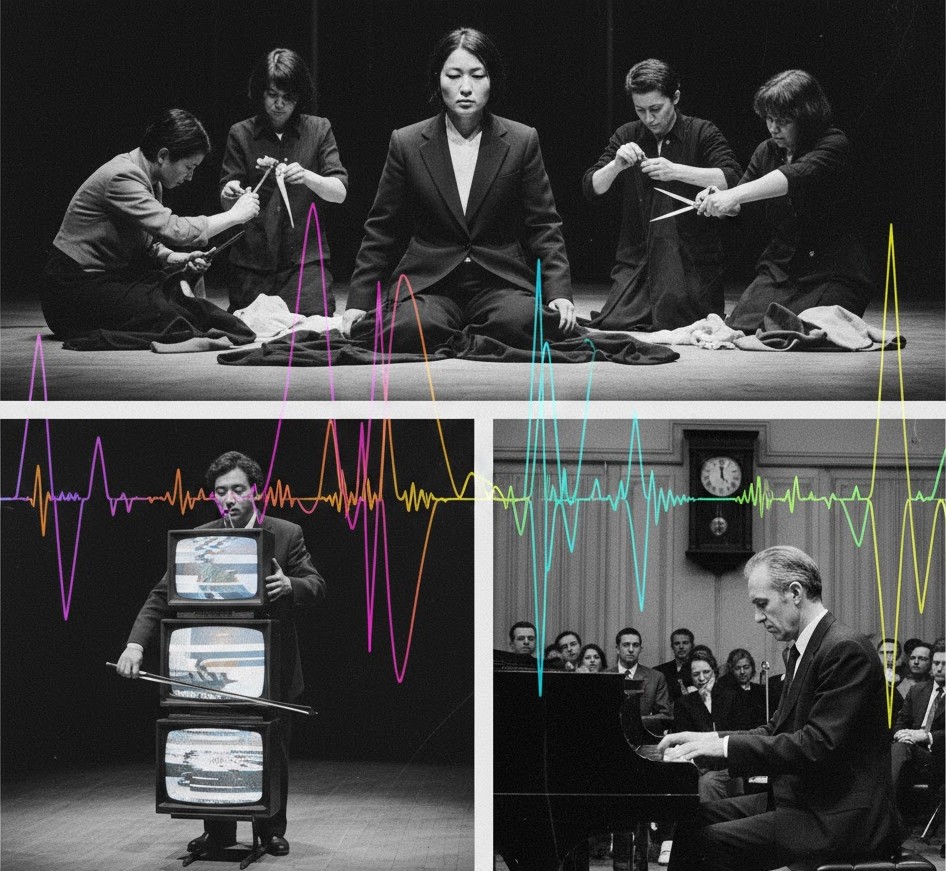
Yoko Ono’s “Instruction Paintings” and “Cut Piece” invited audiences to complete her work — sometimes literally cutting away her clothing while she remained silent on stage.
Ono’s art wasn’t just conceptual; it was emotional and sonic. Her voice performances — raw, primal, untrained — broke traditional definitions of singing. They were expressions of breath, pain, and freedom.
Through Ono, sound became political, feminine, and bodily — a theme that continues to reverberate in contemporary sound performance.
4. Nam June Paik: Television Becomes Instrument
If sound could be art, why not electricity itself? Nam June Paik, a Korean-born visionary, turned video, broadcast noise, and feedback loops into performance. His collaborations with Charlotte Moorman — where she played cello covered in TV monitors or performed topless while reading avant-garde poetry — blurred the line between music, media, and body.
Paik’s hybrid works made technology not just a tool, but a performer. He laid the groundwork for multimedia sound installations — precursors to today’s immersive art experiences.
5. Alison Knowles and Dick Higgins: Everyday Sound
Alison Knowles explored the poetry of daily noise — cooking, brushing, typing. Her “Proposition #2: Make a Salad” instructed participants to chop vegetables as art. The sound of knives, bowls, and chatter became a collective concert.
Her husband Dick Higgins coined the term “intermedia”, describing art that lives between categories — exactly where sound art thrives today.
These works made ordinary acts extraordinary, echoing Artsonify’s belief that beauty hides in vibration itself.
6. From Chaos to Concept: The Birth of Sound Performance
By the late 1960s, Fluxus had ignited a global wave. Performance artists like Joseph Beuys, La Monte Young, and Henning Christiansen treated sound as conceptual sculpture.
The rules had dissolved. Sound could be a protest, a meditation, or a joke. This freedom birthed sound performance art, a genre that turned listening into theater and life into composition.
7. Legacy: When Sound Entered the Museum
What began in small gatherings and lofts eventually entered major institutions — MoMA, the Whitney, the Tate. The radical noise of Fluxus became recognized as the seed of sound art’s legitimacy.
Modern artists like Tino Sehgal, Carsten Nicolai, and Marina Abramović all owe something to this rebellion — the courage to treat sound as meaning, not medium. Fluxus didn’t just break barriers — it made sound art possible.
Conclusion: The Spirit of Fluxus Lives On
Fluxus taught us that art isn’t a product — it’s an event. It’s the moment of vibration between mind and matter.
Artsonify’s practice of transforming music into visual form echoes that lineage: art as process, not possession. When sound becomes visible, it continues Fluxus’s greatest lesson — that creativity is everywhere, waiting to be heard.
Frequently Asked Questions About Fluxus and Sound Performance
1. What is Fluxus?
Fluxus was a 1960s avant-garde movement uniting art, music, and performance to dissolve boundaries between art and life.
2. How did Fluxus influence sound art?
It made sound participatory and performative, paving the way for sound installations and interactive sonic works.
3. Who were the main figures in Fluxus sound art?
Yoko Ono, Nam June Paik, George Maciunas, Alison Knowles, and Dick Higgins were key figures linking sound and action.
4. How did John Cage inspire Fluxus?
Cage’s philosophy of chance and listening transformed Fluxus thinking, turning silence and everyday noise into artistic material.
5. What modern practices come from Fluxus ideas?
Performance art, sound installations, participatory events, and Artsonify’s fusion of sound and visual media all descend from Fluxus experimentation.
Artsonify – “Music, Painted.”