When Machines Learned to Sing: The Rise of Electroacoustic Music
Oct 27, 2025
Introduction: Electricity Meets Imagination
In the mid-20th century, music escaped the concert hall and entered the laboratory. Oscillators, tape machines, and voltage regulators began humming alongside violins and pianos.
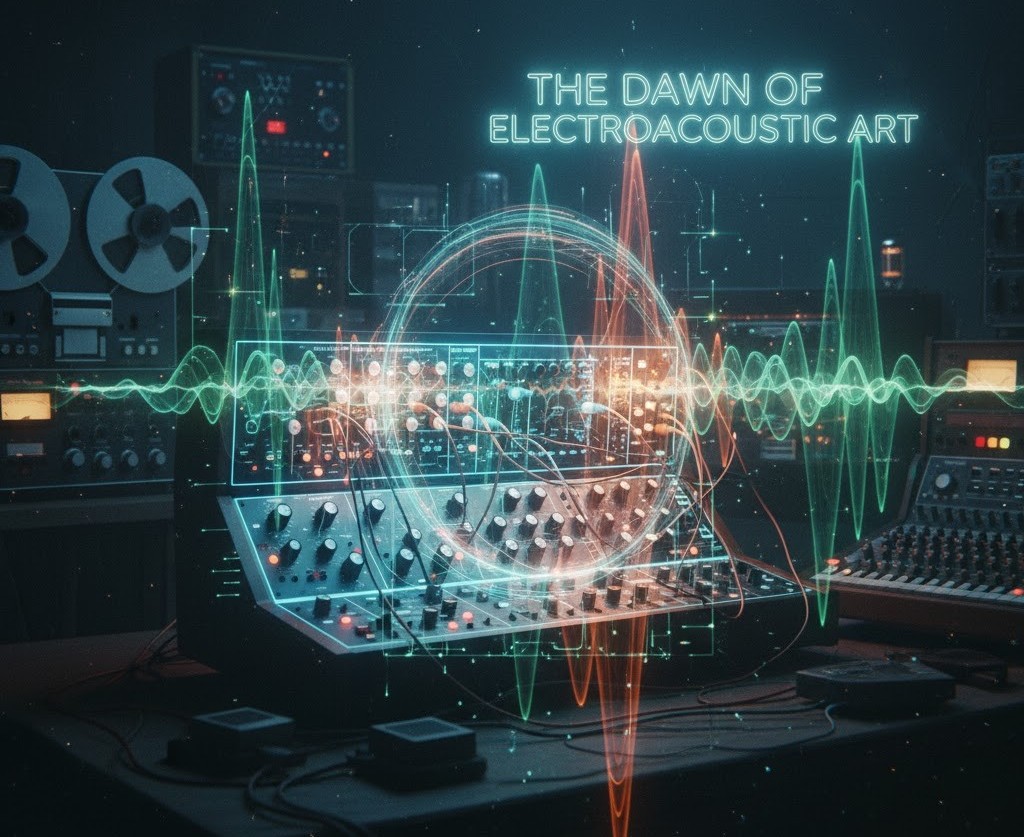
A new frontier was emerging — electroacoustic music — where sound and fused into one living organism. It wasn’t about melody anymore. It was about the physics of emotion, sculpting waveforms instead of notes. This era laid the foundation for everything from ambient and techno to sound installations and Artsonify’s own sonic visualizations.
1. The Bridge Between Musique Concrète and Electronic Sound
While Pierre Schaeffer was splicing tapes in Paris, other pioneers were building circuits elsewhere. Musique Concrète worked with recorded reality; electroacoustic music generated synthetic sound.
The two movements soon converged — both treating sound as raw material to shape.
The idea that art could emerge from voltage, feedback, or static reshaped 20th-century creativity.
2. Cologne: Where Electricity Became Music
In postwar Germany, composer Karlheinz Stockhausen built the Studio for Electronic Music at West German Radio (WDR Cologne). Armed with oscillators and sine wave generators, he produced pieces like “Gesang der Jünglinge” (1956), merging a boy’s voice with pure electronic tone.
This was the first hybrid of human and machine sound — a moment when electricity started to sing. Stockhausen called it “organized sound,” echoing Schaeffer’s philosophy but pushing it into cosmic precision.
Every knob twist became a compositional act. The studio itself had become the instrument.
3. The Global Current: From Tokyo to New York
The electroacoustic revolution spread quickly:
-
Japan: Toru Takemitsu and the NHK Electronic Studio fused poetry and technology.
-
United States: Milton Babbitt, Pauline Oliveros, and Morton Subotnick turned university labs into sonic playgrounds.
-
Eastern Europe: Iannis Xenakis and Bogusław Schaeffer (no relation to Pierre) brought mathematical models and architectural thinking to sound.
Each region added new circuitry, culture, and philosophy — proving that electronic sound was not sterile but culturally alive.
4. The Machines Behind the Music
Electroacoustic music’s early heroes weren’t guitars or pianos — they were devices:
-
Tape recorders: enabled editing, looping, and layering.
-
Oscillators: created pure tones never heard before.
-
Filters & modulators: shaped frequencies into expressive gestures.
-
Early synthesizers: like the RCA Mark II (1957), the world’s first programmable electronic instrument.
Composers became engineers, and engineers became composers. The distinction between art and technology blurred — permanently.
5. From Circuits to Consciousness
By the 1970s, the once-exclusive electroacoustic lab had evolved into the home studio. Portable synths, magnetic tape, and later computers made it possible for anyone to experiment.
The impact was enormous:
-
Brian Eno created ambient soundscapes.
-
Laurie Spiegel built early computer-based composition tools.
-
Pauline Oliveros introduced electronic improvisation and Deep Listening.
This was the democratization of sound creation — where personal emotion met machine precision.
6. The Legacy: Every Sound Is Now Electric
Today, every artist who records, edits, or manipulates sound is part of that legacy. From techno producers to installation artists, the electroacoustic mindset — that sound is matter to be sculpted — drives modern creativity.
Artsonify’s process of transforming frequency data into visual forms is the same philosophy reborn: the studio as instrument, the waveform as paint, the artist as listener-engineer.
Conclusion: When Voltage Found Its Voice
Electroacoustic music taught the world that sound could be designed. It opened the door for musicians to become inventors — and for listeners to become explorers.
Every tone we hear in modern media, from cinematic soundscapes to Artsonify’s painted songs, carries the echo of that revolution. The machines didn’t just learn to sing — they taught us to listen differently.
Frequently Asked Questions About Electroacoustic Music
1. What is electroacoustic music?
It’s music that combines recorded or synthesized electronic sounds with traditional acoustic elements.
2. Who are the main pioneers of electroacoustic music?
Karlheinz Stockhausen, Pierre Schaeffer, Iannis Xenakis, Milton Babbitt, and Pauline Oliveros.
3. How is electroacoustic music different from Musique Concrète?
Musique Concrète uses recorded natural sounds; electroacoustic music generates and manipulates electronic tones.
4. Why is electroacoustic music important?
It introduced new ways of composing, blending art and technology, and paved the way for electronic, ambient, and experimental music.
5. How does Artsonify connect to electroacoustic music?
Artsonify visualizes the same principle — transforming electronic sound frequencies into abstract visual compositions.
Artsonify – “Music, Painted.”